Proper stud gun maintenance is not a routine workshop task—it is a critical factor in industrial stud welding system performance, equipment lifespan, and production stability. For steel structure contractors, OEM manufacturers, and high-duty-cycle welding operations, maintenance directly affects weld consistency, downtime risk, and total operating cost.
As a manufacturer of stud welding machines and complete stud welding systems, ZOC Machinery summarizes below the equipment-level maintenance principles based on long-term field operation and industrial production requirements.
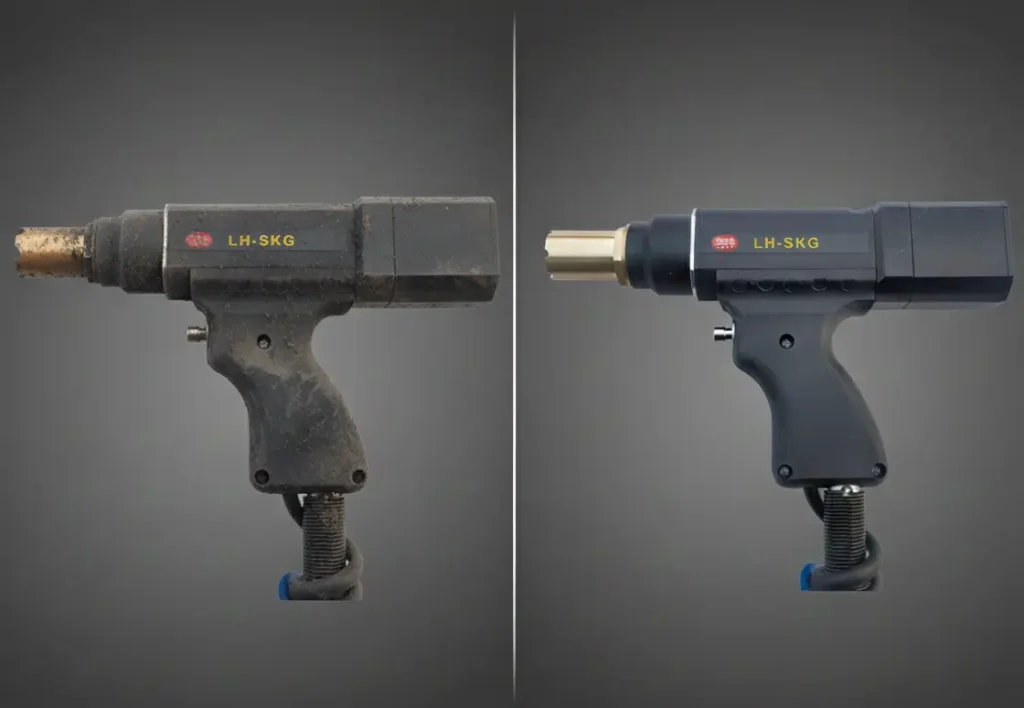
Why Stud Gun Maintenance Matters in Industrial Welding
In drawn arc stud welding, the stud gun operates under high current, repeated thermal load, and continuous mechanical stress. When maintenance is neglected, even high-quality welding machines can experience:
- Unstable arc ignition
- Inconsistent weld penetration
- Increased weld defect rates
- Premature component failure
- Unplanned production downtime
From an industrial perspective, stud gun maintenance is not about cleanliness—it is about maintaining electrical stability and mechanical precision under continuous load.
Key Stud Gun Components That Directly Affect Welding Performance
Chuck and Collet System
The chuck and collet hold the stud in precise alignment during ignition and lift. Wear, deformation, or contamination in this area can result in:
- Misalignment of the stud
- Uneven arc distribution
- Irregular weld collar formation
Regular inspection and timely replacement are essential to maintain repeatable weld quality.
Gun Cable and Electrical Connections
Stud gun cables carry high welding current. Over time, cable fatigue, insulation damage, or loose connections can cause:
- Voltage drop
- Arc instability
- Excessive heat buildup
Manufacturers recommend routine inspection of cable integrity and connection points to prevent electrical loss and overheating.
Lifting Mechanism and Internal Movement Parts
The lifting mechanism controls arc length and ignition timing. Dust, metal particles, or lack of lubrication may affect:
- Lift accuracy
- Arc duration
- Weld repeatability
Smooth and consistent internal movement is critical for stable drawn arc performance.
Insulation and Protective Components
Insulation materials protect operators and prevent current leakage. Degraded insulation increases the risk of:
- Electrical faults
- Equipment damage
- Safety incidents
Any visible cracking or wear should be addressed immediately.
Manufacturer-Recommended Maintenance Practices
From an equipment manufacturer’s perspective, effective stud gun maintenance focuses on preventive control rather than reactive repair:
- Clean critical contact areas regularly to prevent resistance buildup
n- Inspect mechanical wear components based on duty cycle, not only time - Replace consumable parts before failure thresholds are reached
- Keep maintenance records for high-volume production environments
These practices are especially important for applications involving continuous welding, thick base materials, or outdoor construction conditions.
What Happens If Stud Gun Maintenance Is Neglected?
In industrial projects, insufficient maintenance often leads to measurable operational and financial consequences, such as:
- Increased weld rejection during inspection
- Failure in bend or shear testing
- Higher spare parts consumption
- Shortened equipment service life
- Project delays caused by unexpected equipment downtime
Over time, these issues significantly increase the total cost of ownership of the welding system.
Maintenance as Part of Stud Welding System Lifecycle Management
Stud guns should not be viewed as standalone tools. They are integral components of a complete stud welding system that includes:
- Stud welding machines
- Power cables and control units
- Welding consumables and accessories
Proper maintenance ensures that all system components operate within designed parameters, delivering consistent performance throughout the equipment lifecycle.
Who This Guide Is For
This guide is intended for:
- Steel structure and bridge construction contractors
- OEM manufacturers using stud welding in production lines
- Welding supervisors and quality managers
- Equipment procurement and maintenance teams
Understanding maintenance from a system-level perspective helps organizations achieve reliable welding results and long-term operational stability.
Conclusion
Summary: Regular maintenance—from daily cleaning and connection checks to using genuine parts—is the only way to ensure your equipment survives harsh job site conditions.
Resolution: By implementing these simple protocols, you eliminate 90% of common failures, saving your budget and your reputation.
Offer: Need genuine spares or advice? ZOC Machinery provides factory-direct parts and expert support to keep your operations running, no matter where you are.
FAQ
Q1: Can I use standard WD-40 to clean the internal parts?
No, you should not. Standard WD-40 attracts dust and can form a sticky sludge inside the mechanism; you must use a dry-film lubricant or electrical contact cleaner instead.
Q2: How do I know if the solenoid is damaged?
It gets very hot. If the main body of the tool becomes too hot to touch or makes a loud buzzing sound during operation, the solenoid coil is likely failing and requires professional attention.
Q3: What is the best way to remove weld spatter from the chuck?
Use a small file. You should gently file away the spatter without altering the shape of the copper fingers; avoid hammering the chuck as this can damage the internal piston alignment.
Q4: Can I repair a cut control cable with electrical tape?
Only temporarily. While tape works for an emergency fix to finish a shift, you must replace the cable properly as soon as possible to prevent resistance buildup and signal loss.
Q5: How often should I calibrate the lift and plunge settings?
Every setup change. You must recalibrate the settings whenever you change the stud diameter, stud length, or switch to a different base material to ensure consistent weld quality.