
Submerged Arc Stud Welding Machines
Designed for large-diameter stud welding and heavy-duty steel fabrication, the RSM Series uses granular welding flux instead of ceramic ferrules in submerged arc mode. Four IGBT inverter models offer welding currents up to 3,150A and support studs up to Ø36 mm. A separate ceramic ferrule welding mode provides additional flexibility.
Home » Stud Welding Machines » Submerged Arc Stud Welders
RSM SERIES
Submerged Arc Stud Welders (Ø3–36 mm)
Compare four RSM models designed for flux-protected, large-diameter stud welding. Submerged arc welding capacities range from Ø3-22 mm on the RSM-1600 to Ø3-36 mm on the RSM-3150. Each model also supports a separate ceramic ferrule welding mode for different stud sizes and applications.


RSM Series Technical Specifications & Model Comparison
Compare the RSM-1600, RSM-2000, RSM-2500, and RSM-3150 by welding range, output current, input capacity, and weight. The table shows separate specifications for flux-protected submerged arc welding and ceramic ferrule welding, helping you select the right RSM model for your stud dimensions and project requirements.
| Model | Ceramic Ferrule Range | Submerged Arc Range | Welding Current | Input Capacity | Net Weight |
|---|---|---|---|---|---|
| RSM-1600 | Ø3-20 mm | Ø3-22 mm | 200-1,600 A | 60 kW | 80 kg |
| RSM-2000 | Ø3-24 mm | Ø3-26 mm | 200-2,000 A | 70 kW | 92 kg |
| RSM-2500 | Ø3-25 mm | Ø3-30 mm | 200-2,500 A | 85 kW | 94 kg |
| RSM-3150 | Ø3-30 mm | Ø3-36 mm | 200-3,150 A | 110 kW | 155 kg |
Alternative input voltage configurations are available upon request, subject to model specifications and local power supply requirements. Please confirm the required voltage and phase before ordering.
Welding Mode Note: Submerged arc stud welding uses granular welding flux for weld protection and does not require ceramic ferrules. Ceramic ferrules are used in the separate ceramic ferrule welding mode.
RSM SERIES
Key Features for Large-Diameter Stud Welding
IGBT Power Control
Modular IGBT soft-switching provides controlled current output and efficient power conversion for demanding RSM welding operations.
Flux & Ferrule Welding Modes
Submerged arc mode uses granular welding flux without ceramic ferrules. A separate ceramic ferrule mode supports different stud welding applications.
Large-Diameter Welding Capacity
Four RSM models cover Ø3-36mm in submerged arc mode, with the RSM-3150 offering the largest rated stud diameter.
Voltage Compensation
Automatic voltage compensation helps maintain consistent welding parameters when the incoming three-phase power supply fluctuates.
Smart Fan Cooling
Intelligent fan operation reduces unnecessary airflow during standby, helping limit internal dust and metal particle accumulation.
IP23 Industrial Protection
IP23-rated construction and protected circuit boards support operation in demanding industrial environments under appropriate working conditions.
How RSM Submerged Arc Stud Welding Works
The RSM Series uses granular welding flux instead of ceramic ferrules to protect the weld area during submerged arc stud welding. This process is suitable for selected large-diameter ribbed steel bars and heavy-duty industrial anchoring applications.
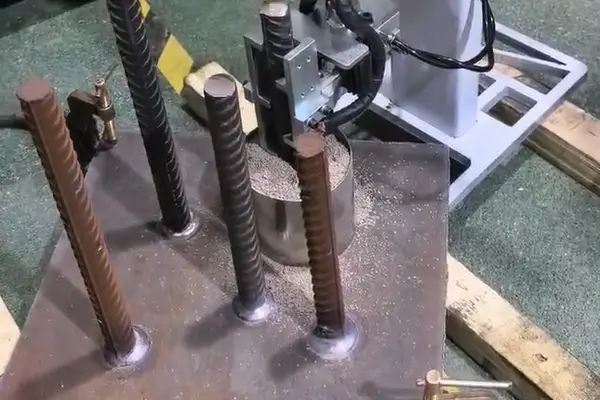
Submerged Arc Welding Setup
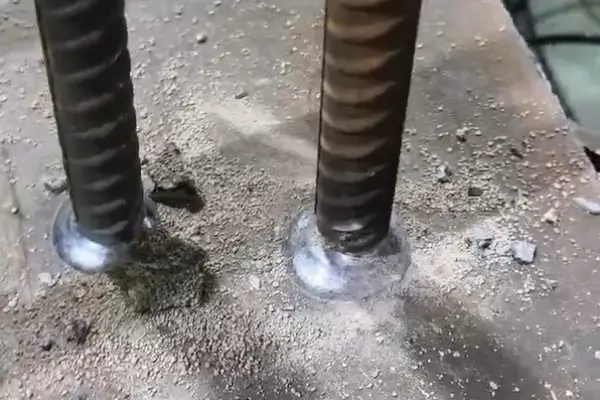
Ribbed Steel Bar Welded Joints
01. Position & Apply Flux
Position the ribbed steel bar on the steel plate and apply granular welding flux around the joint.
02. Arc Melting
A controlled electric arc melts the bar end and base metal beneath the protective flux layer.
03. Join & Inspect
The bar is plunged into the molten metal. After cooling, remove residue and inspect the weld fillet.
Industrial Applications of the RSM Series
From ribbed steel bar-to-plate connections to heavy-duty structural anchoring, RSM submerged arc stud welders support a range of industrial fabrication applications. Explore typical uses in steel construction, infrastructure, and heavy engineering projects.
Ribbed Steel Bar Anchoring
Welding large-diameter ribbed steel bars to steel plates for embedded anchoring assemblies and heavy-duty structural connections.
Structural Steel Construction
Stud and anchor welding applications for structural steel frameworks, embedded steel plates, and industrial building components.
Bridge & Infrastructure
Large-diameter stud welding applications for steel bridge components and infrastructure connections requiring reliable welding procedures.
Heavy Industrial Fabrication
Welding selected steel anchors and fastening components for industrial equipment, plant structures, and heavy engineering projects.
Find the Right RSM Model for Your Project
Welding large-diameter ribbed steel bars or steel anchors? Share your stud diameter, material, base metal thickness, welding mode, and available power supply. We can recommend a suitable RSM configuration and provide technical specifications and a quotation.
RSM Submerged Arc Stud Welding FAQs
Find answers to common questions about RSM submerged arc stud welders, including welding modes, stud diameter capacity, ribbed steel bar applications, model selection, and power supply requirements.
No. The RSM Series uses granular welding flux to protect the weld area in submerged arc mode, so ceramic ferrules are not required. A separate ceramic ferrule welding mode is also available. To explore available types and sizes, browse ceramic ferrules for stud welding.
The RSM-1600, RSM-2000, RSM-2500, and RSM-3150 support submerged arc welding up to Ø22 mm, Ø26 mm, Ø30 mm, and Ø36 mm, respectively. Ceramic ferrule welding has different diameter limits. For the largest model, see the RSM-3150 technical specifications.
Yes. The RSM Series is suitable for selected ribbed steel bars and anchoring components welded to steel plates. Welding suitability depends on bar diameter, material grade, base metal thickness, and the required joint performance. Appropriate welding procedures and testing should be established for each application.
No. RSM submerged arc stud welding is designed to join individual studs or steel anchors to a base material. Conventional submerged arc welding generally uses continuously fed electrodes to produce weld seams. The equipment and intended applications are different.
Start with your required stud diameter and welding mode, then consider the stud material, base metal thickness, welding position, and power supply. The RSM Series offers four models with different current capacities and welding ranges to suit different industrial applications.
The standard RSM Series specification is three-phase AC 380V ±15%. Alternative input voltage configurations may be available upon request, depending on the model and local electrical requirements. Confirm your available voltage and phase before ordering.
The RSM Series features IP23 protection and protected circuit boards for industrial operating environments. However, IP23 does not mean the equipment is waterproof. Suitable shelter, electrical protection, and safe working conditions are still required for outdoor applications.
Please provide the required stud diameter, stud material, base metal thickness, welding application, input voltage, and preferred welding mode. Drawings, welding samples, or project specifications can help our team recommend a suitable RSM model and configuration.