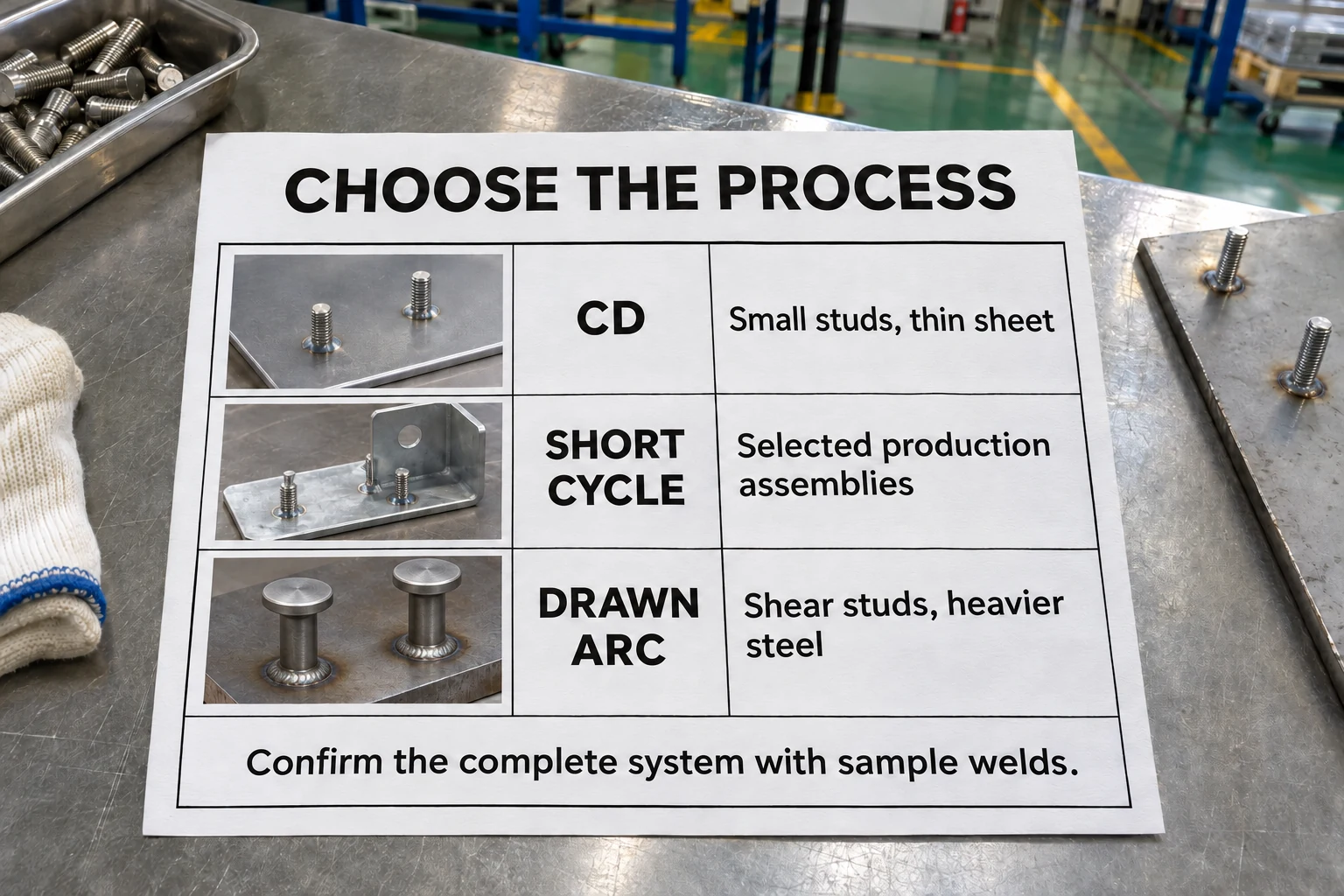
A Drawn Arc Stud Welding Gun holds, lifts and plunges a metal stud during an electrically controlled welding cycle. During a run of shear studs, your crew may face uneven collars and failed trial welds even though the machine has enough current. Each repeat check delays the next section of steelwork. Understanding how manual guns and automated heads control grip, lift and plunge helps you match the equipment and trace faults before production resumes.
What Is a Drawn Arc Stud Welding Gun?
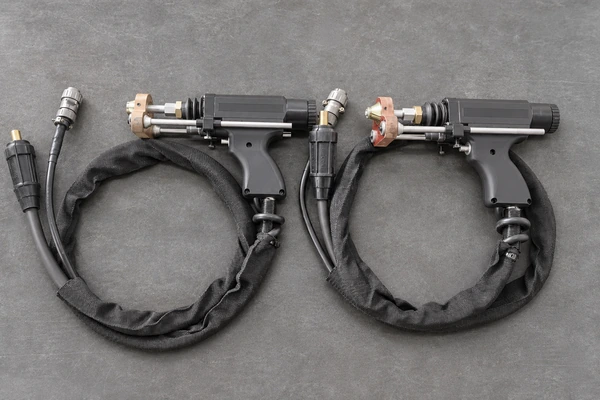
A Drawn Arc Stud Welding Gun is the positioning and movement device used to join a compatible stud to metal through a drawn electrical arc. Its chuck carries current into the stud, while its mechanism controls lift and plunge. The separate power source supplies and regulates welding energy. Depending on the production setup, the gun may be operated manually or integrated into an automated welding system.

What Does the Gun Control?
Start with the moving parts. When you press the gun against the workpiece, its support assembly establishes a reference position. After triggering, the mechanism lifts the stud, holds an arc gap and returns the stud into molten metal.
- The chuck grips and conducts current.
- The lift mechanism creates the arc gap.
- The support assembly steadies positioning.
What Else Does the System Need?
Your setup also needs a compatible welder, welding leads, a work-return connection and suitable studs. Depending on the process, you also need a ceramic ferrule or gas-shielding arrangement.
| System element | Main task |
|---|---|
| Stud welding gun | Hold, lift and plunge the stud |
| Power source | Supply and control welding energy |
| Gun welding lead | Carry welding current between the power source and gun |
| Work-return connection | Complete the circuit through the workpiece |
| Weld stud | Provide the specified fastener and weld end |
| Ceramic ferrule or shielding system | Protect the weld pool as specified by the procedure |
Check these elements together when a weld changes so you can identify the faulty component before replacing equipment.
How Does the Gun Work?
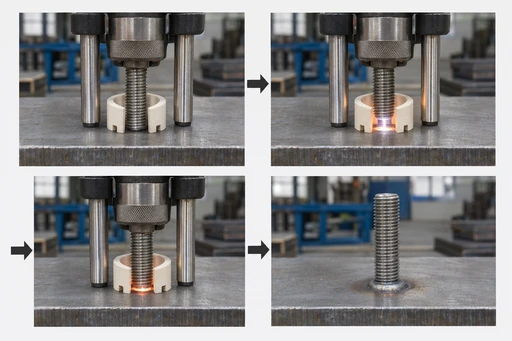
A Drawn Arc Stud Welding Gun works by lifting a contacting stud, sustaining an arc and plunging the stud into molten base metal. After the joint solidifies, you withdraw the gun and remove any disposable ferrule as instructed.
What Happens During the Welding Cycle?
Follow the stud’s movement. Hold the loaded gun steady with the ferrule seated while the system coordinates four stages.
- Contact establishes the starting position.
- Lift draws an arc that melts both joining surfaces.
- Plunge brings molten surfaces together.
- A hold period allows the joint to solidify.
How Do Lift and Plunge Affect Results?
Lift sets the arc gap; plunge moves the stud into the weld pool. The gun and control system must repeat both movements at the prescribed settings. Protrusion establishes available plunge travel; damping controls plunge speed where fitted.
| Motion or setting | What you check |
|---|---|
| Lift | Specified arc gap and repeatable travel |
| Protrusion and plunge | Correct setup and unobstructed movement |
| Damping, where fitted | Model-specific plunge control |
Changing current cannot correct a binding mechanism. Check gun movement against the approved setup before adjusting electrical settings.
Which Components Make Up the Gun?
The body, moving spindle or piston, chuck, supports and electrical connections make up the gun. The required stud welding accessories must match the gun model and compatible consumables. Ferrule-assisted versions also use a ferrule holder.

How Do the Body and Piston Work?
The insulated body houses the drive and moving assembly. Some designs use an electromagnetic lift and spring return, with damping where fitted. Internal drives and lift controls vary by model, so check the parts drawing before ordering replacements. You need smooth axial travel without lateral play or catching.
How Do the Chuck and Ferrule Holder Differ?
Check the two grips separately. The chuck, also called a collet or stud holder in some gun designs, grips the metal stud and transfers welding current. The ceramic ferrule holder positions the ring around the stud’s base. Match both components to the gun model and consumables because they perform different jobs.
- Match chuck geometry to the stud’s gripping section.
- Match ferrule holder dimensions to the ferrule.
- Check that the stud travels freely through the front assembly.
What Do Cables and Connections Carry?
The weld lead carries high welding current; the control connection carries trigger and actuator signals as designed. Control voltages, pin assignments and connectors differ between equipment models. Support rods and feet maintain the front-end position. Use the model-specific stud welding gun parts list to identify replacements.
| Part | Practical inspection |
|---|---|
| Chuck | Firm grip and sound contact surfaces |
| Piston or spindle | Free, repeatable movement |
| Ferrule holder | Correct fit and centering |
| Cables | Intact insulation and secure connections |
Inspect both the electrical path and mechanical assembly.
Key Takeaway: A correct chuck cannot compensate for a misaligned ferrule holder or damaged lead.
What Drawn Arc Stud Welding Gun Configurations Are Available?
A Drawn Arc Stud Welding Gun is available in handheld, extended-reach or standing configurations, and as a purpose-built mounted head. These describe handling and installation, rather than separate welding processes. Conventional drawn arc work may use ceramic ferrules or suitable gas shielding, as specified by the welding procedure.

When Does a Manual Gun Make Sense?
Let access guide the choice. A manual stud welding gun suits changing weld locations, repairs and mixed fabrication work. An extended or standing configuration can help with repeated floor-level welding. For a heavy duty stud welding gun, check capacity and handling with the complete lead and front assembly fitted.
- Check clearance around corners and brackets.
- Evaluate cable drag in the working position.
- Confirm the required stud range and shielding setup.
When Should You Consider a Mounted Head?
An automated stud welding head suits controlled, repetitive positioning. It must match the positioning system, control interface and any required stud-feeding arrangement. Confirm the fixture design and intended drawn arc procedure before integration.
| Configuration | Typical reason to choose it |
|---|---|
| Handheld | Changing locations and flexible access |
| Extended or standing | Repeated work within its reach |
| Mounted head | Fixture-controlled production |
Compare loading, positioning and inspection time with the complete assembly so the configuration suits your actual production method.
How Do You Match the Gun to a Welder?
You match a drawn arc stud welding gun to a welder by confirming the process, electrical interface, control requirements and operating range. When evaluating a specific model, check the compatibility of our YF-DH-22 stud welding gun with the selected power source, cable set and usable stud range. A connector that physically fits provides only part of that evidence.

Which Specifications Should You Compare?
Check beyond the plug. Stud welding gun compatibility depends on the drive controls and the current path as well as physical connections. Excessive cable length or insufficient conductor cross-section can increase voltage drop. Cable selection must also account for current-carrying capacity and the permitted duty cycle.
- Record required welding current (A), weld time (ms) and repetition rate.
- Confirm stud diameter, lift and plunge ranges (mm) for the prescribed setup.
- Specify lead length (m), conductor area (mm²), connectors and polarity.
- Confirm control voltage, pinout and actuator requirements.
How Should You Verify a Replacement Gun?
For example, replacing a gun for 19 mm shear studs requires more than the stud diameter: send the welder model, stud drawing, chuck requirements, cable configuration, control interface and intended welding procedure. That diameter alone cannot establish gun compatibility. After written confirmation, follow the commissioning instructions and make the prescribed trial welds with production-representative studs and base metal.
| Check | Evidence you need |
|---|---|
| Control compatibility | Voltage, pin assignment and approved gun–welder pairing |
| Operating capacity | Current, weld time, stud range and repetition limits |
| Cable arrangement | Length, conductor area and connection specification |
| Welding performance | Accepted trials using the confirmed configuration |
Written compatibility details make a replacement easier to commission and support.
Key Takeaway: Approve the gun–welder combination using specifications and trials before production.
Where Is Drawn Arc Stud Welding Used?
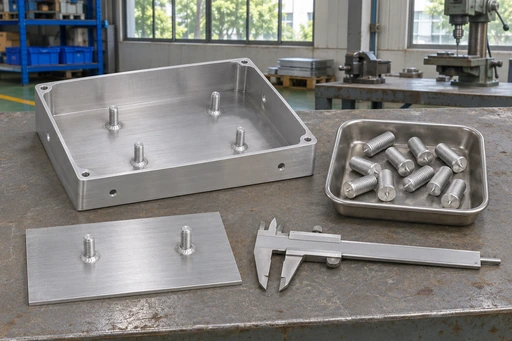
A Drawn Arc Stud Welding Gun is used for shear connectors, mounting studs and compatible industrial anchors on suitable metal. Structural steel, shipbuilding and machinery fabrication are common settings. Stud design, base-metal thickness and service requirements determine whether a particular joint suits the process.

What Does It Do in Structural Steelwork?
Headed shear studs transfer shear between steel and concrete in composite members, including bridge girders. Use drawn arc installation only where the stud specification and welding procedure suit the joint. Welding directly onto a beam differs from welding through decking, which requires suitable deck conditions and consumables. Select ceramic ferrules for the stud, welding position and direct-to-steel or through-deck application.
Which Other Jobs Can It Support?
Look at the attachment duty. A shipyard mounting stud and a furnace anchor face different loads, temperatures and installation conditions. Some insulation pins require a different welding process, so confirm the fastener’s weld-end design and specified installation method.
- Mounting studs need suitable material, base-metal thickness and access.
- Insulation fasteners need explicit approval for the drawn arc setup.
- Refractory anchors need a suitable weld end, chuck and heat-resistant material.
| Application | Detail to confirm |
|---|---|
| Composite construction | Connector design and welding procedure |
| Machinery mounting | Stud material, loads and access |
| Insulation or refractory fixing | Fastener process, anchor geometry and service temperature |
Confirm the fastener’s installation method and service conditions before specifying the gun; an industry label cannot establish joint suitability.
What Can Go Wrong with a Drawn Arc Stud Welding Gun?
Worn chucks, sticking moving parts, misaligned supports and intermittent trigger connections are common gun-side faults. Routine Drawn Arc Stud Welding Gun maintenance helps you identify wear before it affects stud grip, motion or positioning.

Which Gun Parts Match the Symptom?
Watch the gun’s movement. Isolate the equipment before physical checks, then use the specified diagnostic or lift-test mode as instructed. Keep any failed sample and note whether the symptom follows the same gun.
- Check chuck wear and fit when a stud slips or loads loosely.
- Check the spindle, piston and spring where fitted when travel sticks.
- Check support feet and the front assembly when the stud sits off-axis.
- Have intermittent trigger or control-cable faults checked by service personnel.
How Do You Confirm the Cause?
After correcting the suspected gun fault, repeat the specified movement checks and conduct trial welds under the approved procedure. Confirm that the repaired gun meets the required welding and inspection criteria before returning it to production. A neat collar does not prove internal fusion. For welding parameters, surface preparation, arc stability and weld-quality faults, see common stud welding problems and solutions.
| Gun symptom | Parts or setup to check |
|---|---|
| Unstable stud grip | Chuck wear, bore and gripping profile |
| Irregular movement | Piston, spindle and spring where fitted |
| Incorrect lift or plunge | Drive mechanism and model-specific setup |
| Poor stud alignment | Support feet and front assembly |
| Intermittent operation | Trigger, control cable and connections |
A symptom identifies checks rather than proving a cause.
Key Takeaway: Record the repair, movement-check results and accepted trial welds so you can trace a recurring fault to the same gun.
How Should You Maintain the Gun?
Maintain a Drawn Arc Stud Welding Gun by inspecting its chuck, moving assembly, supports, cables and connectors according to its manual. Isolate equipment before adjustments or service as instructed. Cleaning and lubrication methods vary between models.

What Belongs in Your Routine Check?
Start where wear changes the weld. Chuck wear affects grip and contact; spatter around the front assembly can obstruct movement. Damaged feet can change seating even when the gun still triggers.
- Inspect visible insulation and connector damage.
- Remove debris using the approved cleaning method.
- Check chuck fit, support alignment and free movement.
- Record replaced parts and abnormal behavior.
When Does the Gun Need Service?
Stop using a gun with damaged insulation, intermittent operation or abnormal movement. Internal electrical repairs and drive faults need competent service personnel. Avoid applying grease or solvents without model-specific instructions.
| Finding | Suitable response |
|---|---|
| Worn chuck | Fit the specified replacement |
| Damaged lead | Remove from service and repair correctly |
| Binding movement | Investigate before further welding |
After service, verify setup and trial performance before returning the gun to work, and record recurring faults by gun identity.
What Must You Confirm Before Ordering a Drawn Arc Stud Welding Gun?
Before ordering a Drawn Arc Stud Welding Gun, confirm your stud specification, welder model, front assembly and cable details. Review our YF-DH-25 stud welding gun as a product reference, and use our stud welding gun selection guide for the wider comparison. Record the agreed configuration in the quotation.

What Belongs in the Technical Order Specification?
Make the order specific. Send the information needed to identify the gun assembly and its supplied parts.
- Stud drawing, diameter, length and material; base-metal grade and thickness.
- Exact compatible welder model and approved gun configuration.
- Chuck size, ceramic ferrule holder and support assembly references.
- Welding cable length, conductor area and power/control connections.
- Working position, access and required production rate.
What Should the Supplier Confirm in Writing?
Request an itemized configuration with replacement-part references and any limits on the proposed cable arrangement. Agree on representative trial materials and acceptance checks before dispatch or commissioning.
| Order item | Written confirmation |
|---|---|
| Gun and power source | Exact model pairing and interface |
| Front assembly | Chuck, ferrule holder and support references |
| Leads and acceptance | Cable specification and agreed trial checks |
Resolve missing part references and compatibility details before approving the order so your receiving team can check the delivered assembly against the specification.
What Else Should You Know About Drawn Arc Stud Welding?
Before using a Drawn Arc Stud Welding Gun, confirm interchangeability, shielding, lift/plunge setup and weld-acceptance requirements against your model instructions and project procedure.

Frequently Asked Questions
Check these points before ordering or restarting work.
Can I use a drawn arc gun on my CD stud welder?
Usually no. Conventional drawn arc and tip-ignition CD systems use different operating sequences and controls; use only a combination expressly approved for that equipment.
Can I use a drawn arc stud welding gun without a ceramic ferrule?
Yes, with an approved gas-shielded drawn arc setup. The gun, power source and procedure must support it; do not remove the ferrule from a procedure that requires ferrule protection.
What’s the best gun for repeated shear stud welding?
A compatible gun rated for your stud and production cycle. Also compare reach, handling, cable requirements and the support arrangement in your actual working position.
How do I know if my lift and plunge are correct?
Check them against your model manual and approved welding setup. Use the specified movement checks and trial welds rather than a universal setting copied from another gun.
How do I know if my finished weld is acceptable?
Apply your project’s inspection and test criteria. Collar appearance can reveal surface problems, while required mechanical tests or section examination provide other evidence about the joint.
You can now identify gun parts, check motion and specify a compatible setup. We can help match the gun, power source, front assembly and consumables to your job. We recommend equipment on confirmed compatibility and verified trial results. Contact us today with your stud drawing and welder details for a configuration review.