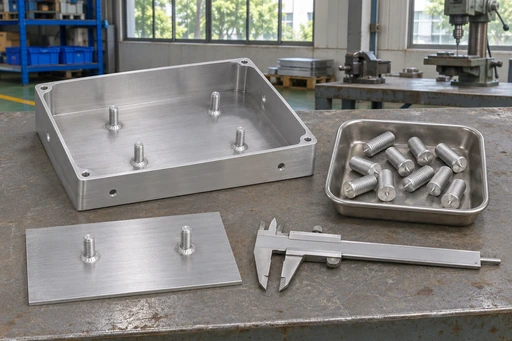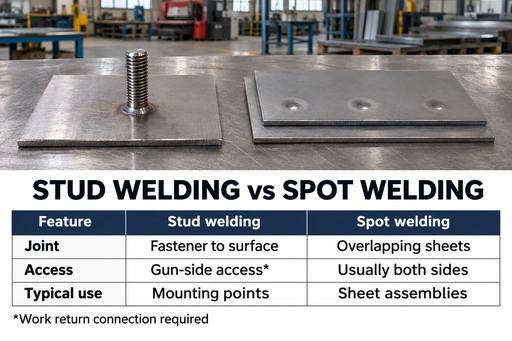
Aluminum stud welding joins aluminum fasteners to compatible aluminum parts using a brief electrical arc and controlled stud movement. CD suits many small fasteners on thin sheet; gas-shielded arc processes serve other qualified combinations.
When an aluminum stud detaches during assembly, you lose a fastening point and may have to scrap a finished panel. Changing settings without checking the material, surface, and gun action can waste more parts. A controlled process starts with compatible alloys, clean weld surfaces, and representative trials. Use our comparison of CD and drawn arc welding to narrow your options before choosing equipment.
What Materials Can Be Joined Using Aluminum Stud Welding?
Compatible aluminum studs and aluminum sheet, plate, or extrusions can be joined once the material pairing and welding procedure have been validated. The alloy, temper, thickness, and service loads determine whether a proposed joint is suitable.
Where do welded studs fit your assembly?
Enclosures need mounting points; lightweight housings need brackets and cable supports. These are useful starting points when reviewing industrial stud welding applications, but each aluminum assembly needs its own material and load checks.
- Electrical enclosures and instrument panels
- Equipment covers and sheet-metal housings
- Qualified automotive and lightweight assemblies
Define the load before choosing the fastener
Specify pull loads, shear loads, tightening torque, vibration, and corrosion exposure before selecting a stud. Welding can place an attachment from one accessible side, although the work return still needs a sound electrical connection.
A mounting stud that survives nut tightening may still need fatigue or environmental testing. An enclosure panel may also have a backside appearance limit that a hidden equipment bracket does not.
Which Stud Welding Process Works Best for Aluminum?
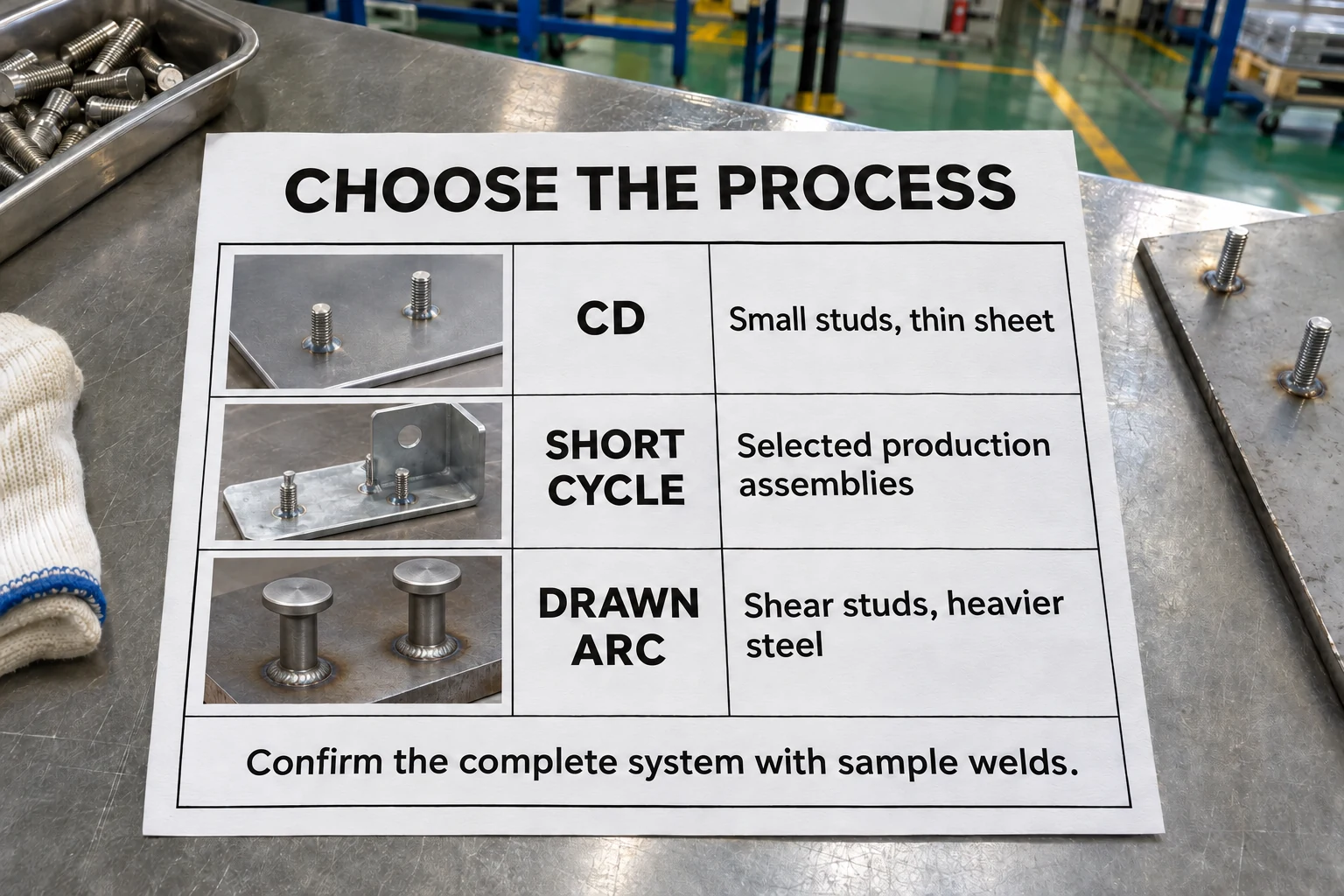
Capacitor discharge (CD) stud welding is often suitable for small studs on thin aluminum sheets. Gas-shielded drawn arc stud welding, including short-cycle variants, may suit other applications when the equipment, stud design, and welding procedure are specifically qualified for aluminum.
When should you consider capacitor discharge?
Tip-ignition CD uses a purpose-made stud with an ignition projection and a brief discharge. Contact and gap systems have different gun actions; fast, controlled stud arrival helps limit heat loss before the molten surfaces meet.
- Compare contact and gap capability before ordering.
- Match the stud tip and gun to the selected process.
- Evaluate backside marking on representative panels.
Available capacitor discharge stud welders are equipment candidates, not proof that every listed diameter can be welded in aluminum. Request confirmation for your actual application.
Where do drawn arc and short cycle fit?
Gas-shielded drawn arc melts the stud end and base surface before plunge; aluminum arc weld studs must have the weld-end geometry specified for that system. Short-cycle drawn arc uses a shorter arc sequence and still needs an aluminum-compatible power source, gun, stud, and shielding arrangement.
| Process | Typical reason to evaluate | Qualification focus |
|---|---|---|
| Tip-ignition CD | Small studs, thin sheet | Tip geometry and gun speed |
| Drawn arc | Compatible heavier joints | Gas coverage and arc control |
| Short-cycle drawn arc | Controlled short arc sequence | Aluminum-specific configuration |
Key Takeaway: Compare results on your parts; published steel diameter ranges do not establish aluminum capacity.
Why Is Aluminum Harder to Stud Weld Than Steel?
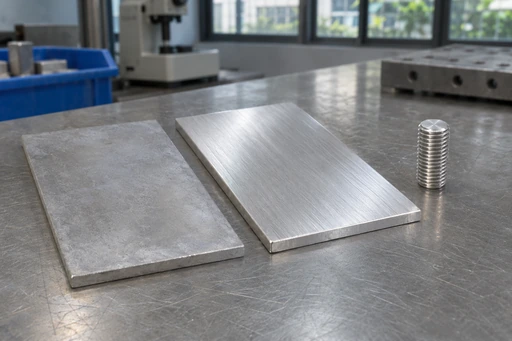
Aluminum requires closer control because surface oxide obstructs fusion and the base metal conducts heat away rapidly. Small changes in preparation or gun movement can make a previously acceptable setup unreliable.
A visually clean surface may still carry contamination
Aluminum develops an oxide film even when you cannot see obvious corrosion. Oil, moisture, and coating residues can interfere with fusion and contribute to porosity.
- Prepare the weld location using the approved cleaning method.
- Keep prepared coupons dry and free from handling contamination.
- Investigate fracture surfaces alongside mechanical test results.
Why does stud movement change the result?
The stud must reach the molten base surface within the process window. Gun friction, unsuitable spring settings, or incorrect lift and plunge can change that timing even when the electrical settings remain unchanged.
For stud welding aluminum, a voltage adjustment cannot correct every mechanical or surface problem. Check the full setup before attributing a failed joint to insufficient energy.
How Do You Prepare and Weld Aluminum Studs?
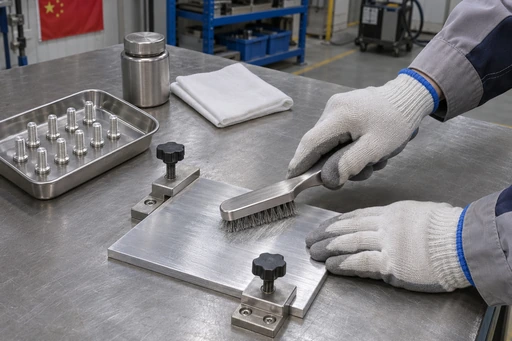
Prepare compatible, uncoated weld surfaces, establish a reliable electrical return, and set up the gun according to its manual. Run the proposed setup on representative coupons before using it on finished parts.
How do aluminum alloy grades affect weldability?
Specify the full alloy and temper for both the workpiece and aluminum weld studs; a description such as “aluminum panel” is incomplete. The 5xxx and 6xxx designations identify alloy families, while H32 and T6 describe material condition. Welding heat can alter local properties, so the parent material’s strength rating does not establish the finished joint’s capacity.
| Material detail | Information needed for a trial |
|---|---|
| Base metal | Exact alloy, temper, and thickness, such as 5052-H32 sheet or 6061-T6 extrusion |
| Weld stud | Alloy, diameter, flange, and weld-end geometry |
| Surface | Bare, anodized, painted, or otherwise treated |
| Service conditions | Loads, temperature, and corrosion exposure |
For example, an M4 aluminum weld stud on a 1 mm 5052-H32 sheet can provide a starting point for a feasibility trial, not a pre-approved welding combination. The stud alloy, welding process, required joint strength, and acceptable backside marking must still be verified. The weld stud selection guide explains broader fastener specifications.
Clean and fixture the workpiece
Remove grease with an approved cleaner, let the surface dry, then remove oxide using the specified method. Keep stainless steel brushes dedicated to aluminum and weld promptly after preparation.
- Remove paint or anodizing locally from the weld area.
- Support thin panels without obstructing the gun.
- Attach the work return to clean conductive metal.
Set up the gun and complete the welding cycle
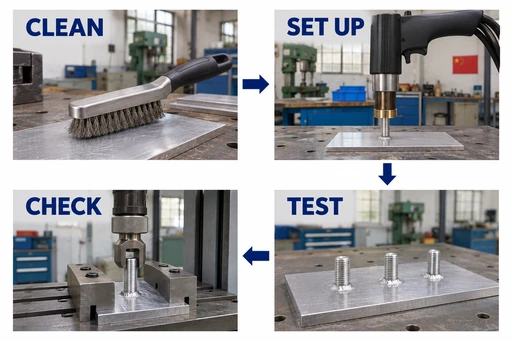
Start on a representative coupon. Follow the equipment manual for cable connections, polarity, and gun adjustments; aluminum arc systems can require a different polarity from common steel configurations. Our stud welding process guide provides general setup context, while your equipment instructions define the actual aluminum configuration.
- Fit the specified collet and front-end accessories.
- Set the approved starting energy or current/time and gun movement.
- Confirm shielding where required, position the gun squarely, and complete the cycle.
- Use specified eye protection, clothing, and ventilation.
Key Takeaway: Record the setup you used and release finished parts only after the required quality checks have passed.
Which Settings Control Aluminum Stud Welding Quality?
Electrical energy, arc duration where adjustable, gun movement, joint geometry, and shielding all affect weld quality. These variables interact, so a universal current or voltage setting would be misleading.
How do energy and movement work together?
CD machines control stored energy through charging voltage and available capacitance. Arc systems control current and time; lift, plunge, and mechanical travel affect how the molten surfaces meet.
Change one variable, then test again. Keep the alloy, stud diameter, thickness, and preparation method fixed during comparisons. A setting that reduces backside marking but fails the required mechanical test has not met your acceptance criteria.
What should you verify about shielding gas?
Aluminum drawn arc commonly uses argon or an approved argon-helium arrangement, with delivery and flow set by the applicable procedure. Tip-ignition contact and gap CD generally operate without external shielding; drawn-arc CD is a different variant and can require gas.
| Variable | What an unsuitable setting can affect |
|---|---|
| Energy or current/time | Fusion, distortion, or burn-through |
| Lift and plunge | Arc stability and final seating |
| Gas delivery | Weld protection and porosity |
| Cable and return condition | Repeatability of delivered energy |
Key Takeaway: Qualify the complete combination, including gun motion and shielding, rather than approving one electrical setting in isolation.
How Do You Troubleshoot Aluminum Stud Weld Defects?
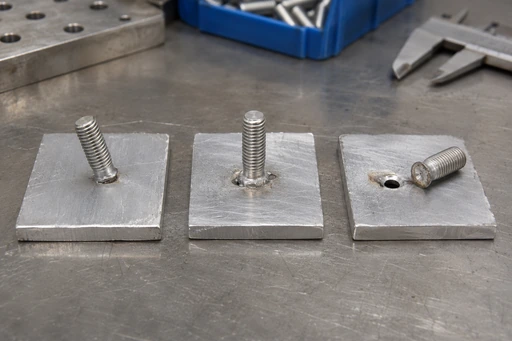
Start with material identification, surface preparation, gun action, electrical delivery, and shielding before changing settings. A visible defect suggests possible causes; it rarely proves one cause by itself.
What should you investigate when a stud detaches?
Keep the failed sample and compare its weld face with mechanically tested samples. Check whether the preparation method, stud lot, or setup changed; a shiny or partially fused surface requires investigation but does not establish joint strength by itself.
- Confirm the stud alloy and weld-end geometry.
- Inspect return clamps, cable connections, and collet grip.
- Check that the gun moves freely and seats squarely.
Use controlled trials to separate possible causes
Excessive heat input can damage thin sheet, while insufficient fusion may involve energy, contamination, or timing. The common stud welding problems and solutions guide covers broader diagnostic methods that can support your investigation.
| Symptom | Possible causes | Next check |
|---|---|---|
| Weak joint or incomplete fusion | Oxide, low energy, unsuitable movement | Preparation and gun travel |
| Porosity | Contamination or poor shielding | Dryness, cleanliness, gas coverage |
| Spatter | Unstable arc or unsuitable settings | Connections and process settings |
| Burn-through | Excess heat for the joint | Energy, thickness, stud geometry |
Retest after each adjustment and record the failure mode, so you can distinguish a repeatable fix from an isolated acceptable weld.
How Do You Choose an Aluminum Stud Welder?
Choose an aluminum stud welder by requiring a demonstration on your alloy, stud, thickness, and production conditions. A steel capacity rating or a gas connection alone does not establish aluminum suitability.
What should your supplier demonstrate?
Compare stud welding machines by supported process, gun configuration, adjustment range, and repeatability. Request the complete aluminum stud welding machine configuration in writing, including any required gas and front-end accessories.
- Provide stud and sheet alloys, dimensions, and finish.
- Specify required loads and backside appearance limits.
- Confirm power supply, work rate, and automation needs.
- Agree on trial evidence and spare-parts support.
The stud welding supplier selection guide can help you compare technical support and acceptance commitments alongside equipment specifications.
Compare the complete quotation
Include guns, collets, gas accessories, cables, fixtures, and operator guidance. A proposed CD system should explicitly identify contact, gap, or both capabilities, rather than relying on a general aluminum compatibility claim.
| Buying question | Useful evidence |
|---|---|
| Does it weld this combination? | Representative trial and test record |
| Will it fit production? | Demonstrated cycle and recharge performance |
| Can you maintain it? | Parts list and support scope |
Key Takeaway: Purchase a demonstrated configuration with agreed acceptance criteria so equipment delivery leads to a usable process.
How Do You Verify Aluminum Stud Weld Quality?
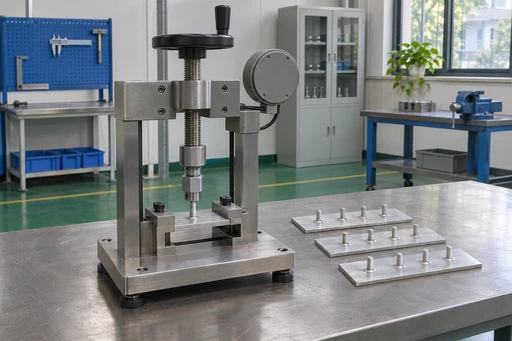
Verify quality through specified visual checks, mechanical tests, and traceable records on representative joints. Our stud welding inspection guide provides general inspection context; the drawing and applicable procedure determine your aluminum joint’s acceptance requirements.
How do you check strength and failure mode?
Inspect position, perpendicularity, seating, and sheet damage, then perform the mechanical tests required for the application. Appearance alone cannot confirm load capacity, and one test method does not establish every service requirement.
- Use bend tests where specified to check joint integrity.
- Use defined torque or tensile tests when required by the acceptance plan.
- Record the load or test condition and whether failure occurred in the stud, weld, or base material.
- Add fatigue or environmental testing when service conditions require it.
Apply the validated procedure during production
Define checks at startup and after relevant changes in material, settings, consumables, or equipment condition. Retain the alloy and stud lot, preparation method, machine and gun settings, sample results, and disposition of any failures.
Set the sampling frequency before production and investigate drift before releasing affected parts. Repeated visual checks do not replace mechanical checks required by the control plan.
Which standards apply to aluminum stud welding?
EN ISO 14555:2025 provides requirements for arc stud welding of metallic materials, including welding procedure qualification, operator qualification, and production testing. AWS D1.2 may apply to structural aluminum welding where specified by the project. Before qualification, confirm the applicable standard, edition, process coverage, and acceptance criteria with the project engineer, including any earlier edition required by the contract.
| Reference | Role in the acceptance plan |
|---|---|
| EN ISO 14555:2025 | Stud welding procedure, qualification, and testing requirements |
| AWS D1.2 | Applicable structural aluminum welding requirements |
| Customer drawing and approved procedure | Joint geometry, loads, tests, and acceptance limits |
AWS D1.1 concerns steel and is not a default acceptance basis for aluminum joints. Agree on the governing standard, sampling plan, test thresholds, and permitted failure modes before testing.
What Aluminum Stud Welding FAQs Do Buyers Ask?
Buyers commonly ask about material compatibility, coatings, process selection, shielding, and acceptance testing. Resolve these points before committing equipment or finished parts.
Can I weld aluminum studs directly to steel?
Generally, no with a conventional aluminum stud welding setup. Dissimilar fusion joints need a specially engineered joining solution and validation; ordinary aluminum-to-aluminum settings do not establish suitability.
Can I weld through anodizing or paint?
No, standard fusion welding requires a suitably prepared conductive weld area. Remove the coating locally using the approved procedure, then address corrosion protection and finish requirements afterward.
Which stud welding process is best for thin aluminum sheets?
CD is often a suitable candidate for small studs. Confirm contact or gap capability and test your actual thickness, alloy, and backside appearance requirements.
Can I weld without shielding gas?
Yes, tip-ignition contact or gap CD generally can. Aluminum drawn arc, including drawn-arc CD, requires the specified shielding arrangement; check the exact process designation.
How do I know if my weld is strong enough?
Verify it against specified mechanical acceptance criteria. Appearance alone cannot establish strength, and a bend test does not replace every tensile, fatigue, or service-load requirement.
Conclusion: Which Aluminum Stud Welding Process Fits?
Choose CD for suitable small-stud, thin-sheet applications, and evaluate gas-shielded arc options against the actual joint requirements. Reliable aluminum stud welding depends on compatible alloys, prepared surfaces, controlled gun movement, and evidence from representative tests.
Request a configuration review
Share your aluminum alloy and temper, stud drawing, base thickness, required loads, and production target. Our team can review equipment options and help identify the trials needed to verify a suitable configuration.
We recommend equipment against a defined joint and measurable acceptance criteria. Send your application details and contact us today for technical support and equipment selection.